How artificial turf installation works in Scottsdale
Nine steps for professional artificial turf installation in the Valley. The ones that decide whether you are happy in year ten happen before the turf comes off the roll.
Nine steps for professional artificial turf installation in the Valley. The ones that decide whether you are happy in year ten happen before the turf comes off the roll.
Artificial turf installation in Scottsdale succeeds or fails on three local variables: caliche depth, monsoon drainage, and UV-stable product that will not bleach by year four. The steps below are the same sequence we use on residential lawns and desert conversions across the city — including HOA communities where architectural packages have to travel with the quote.
We lay out the area, mark utilities, confirm edges against granite, hardscape and block wall — and probe for caliche depth. That last one is specific to this valley and determines both the price and the plan.
Three to four inches of existing grass, root mass or old granite comes out and gets hauled away. Where caliche sits shallow, this is where the real work happens. Organic material left underneath decomposes and the surface settles unevenly.
Where caliche blocks proper base depth it has to be broken through rather than built on. This is the step budget installers skip, and it is invisible once turf is down. More on caliche.
The subgrade is shaped to move water toward an outlet. In a block-walled back yard there may be no natural outlet, so one gets designed — French drain, dry well through the hardpan, or a tie-in to existing drainage. Monsoon storms deliver a lot of water in a short window.
Crushed aggregate in lifts, not one deep layer, each compacted before the next, to a finished depth of three to four inches. This is the structural foundation.
Plate compactor across the whole surface with a final grade check, targeting around 90 percent compaction. Under-compacted base is the most common cause of ruts appearing in years two and three.
Permeable fabric between base and turf where the site warrants it. Less universally necessary here than in wetter climates, but useful where Bermuda rhizomes are present — Bermuda is persistent and will find a way up if anything is left.
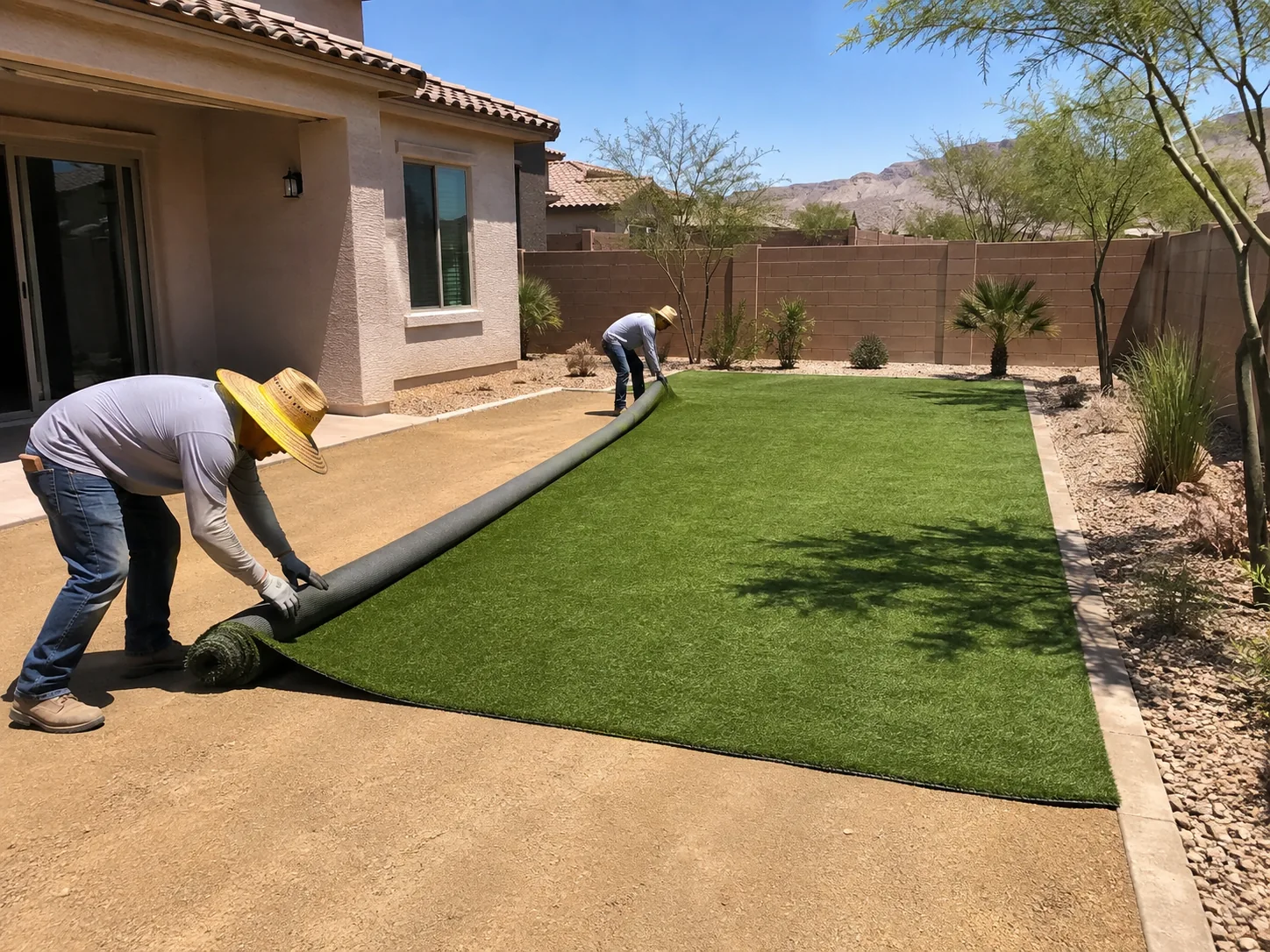
Turf is rolled out and left to relax in the sun so it loses roll memory before cutting — which happens fast here. All panels laid the same direction, since opposing grain shows as a visible colour difference. Seams joined with tape and adhesive, blades hand-worked across the join.
One local note: turf expands in extreme heat. Installing without accounting for thermal movement is what produces the buckling that shows up the following July. Panels need to be stretched properly and anchored to allow for it.
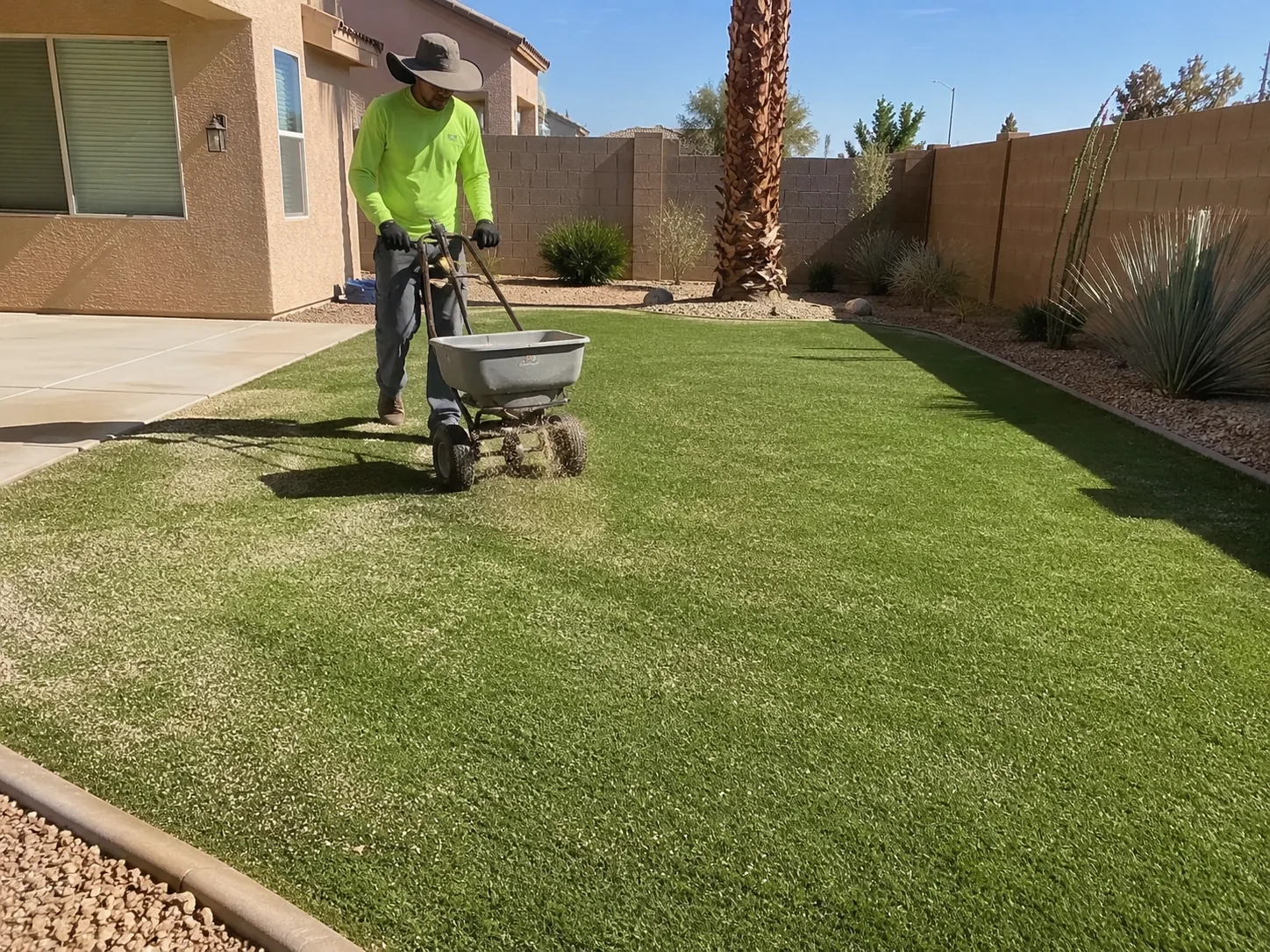
Perimeter secured with nails, staples or bender board depending on edge condition. Infill spread evenly and worked down between fibres, then power broomed to stand blades up. Infill weighs turf down, protects fibres from crushing, and gives the surface its feel.
Most residential yards one to two days. Desert front yard conversions often a single day. Putting greens two to four. Shallow thick caliche adds time.
If a quote does not mention excavation depth, base depth, compaction and caliche, ask. Those four things are the job. A quote listing only the turf product tells you about the part you can see and nothing about the part that fails.
Most estimates are scheduled within 48 hours.
Tell us the space and we’ll give you a firm, written price. No pressure, no obligation.